 FLYSCOUT
Why is my plane circling? Holding patterns, and how long they last
If your plane is circling before landing, it is almost certainly in a holding pattern, flying laps of an oval at a set height while it waits for its turn to land. Most holds are short. At Heathrow, the aircraft that had to hold in 2025 spent an average of under seven minutes in the stack; a hold of 20 minutes or more is unusual.
Circling before landing feels like something has gone wrong, but it is one of the most ordinary things an airliner does. The pilots are flying a holding pattern, and air traffic control is using it to line up more aircraft than the runway can take at once.
What a holding pattern is
A hold is a racetrack: two straight legs joined by two half-circle turns, flown around a fixed point called a holding fix. Each hold is published in official aviation documents, so pilots and controllers know exactly where it is. In the standard pattern the turns are to the right, and the leg flown towards the fix lasts one minute at or below 14,000 ft and a minute and a half above it, so one lap takes about four to five minutes. Holds are flown slowly to save fuel and keep them compact: under ICAO's rules, no faster than 230 knots up to 14,000 ft and 265 knots up to 34,000 ft.
Where several aircraft wait at once, the hold becomes a stack. NATS, which runs air traffic control in the UK, describes how it works: aircraft usually join at the top, around 15,000 ft, and leave from the bottom, around 7,000 ft. The levels are normally 1,000 ft apart, so up to eight aircraft can hold in one stack. Controllers tell each crew which level to enter, when to step down, and when to leave for the airport.
Why planes hold
NATS gives three kinds of reason:
- Many flights arriving at once. A runway can only take one landing at a time, with a safe gap between each. Holding lets controllers build an orderly queue.
- Weather that slows landings. Fog, low cloud or strong wind reduce the rate at which aircraft can land, so the queue grows.
- Operational reasons. An aircraft ahead taking longer to land or leave the runway, a temporary restriction, or a change of runway direction.
Holds are not only for the busiest airports or the peak hours. A short hold at a quiet airport, while a runway is inspected or the wind changes, is just as normal.
How long holds last
At a busy airport most holds are short. Heathrow publishes the figures: in 2025, an average of 264 aircraft a day had to hold, roughly four in ten of its arrivals, and they spent an average of 6.66 minutes in a stack, down from 7.15 minutes in 2024. When the holding delay is expected to approach 20 minutes a flight, Heathrow may land aircraft on both runways for a while, to clear the stacks.
That is why FlyScout calls a hold unusual only when it lasts 30 minutes or more, and names it "Long holding". On its first full day of watching the world around the clock, from 15 to 16 October 2026, it still counted holds from 20 minutes, and found 34, 6 of them lasting 40 minutes or longer; that was too many to call unusual, and it raised the bar to 30 minutes the same day. The longest was 49 minutes: an Air Arabia Airbus A320 that flew seven and a half laps near Fujairah, in the United Arab Emirates, before landing at Sharjah. Five other Air Arabia flights held at the same spot within the same hour.
What a long hold looks like on a flight tracker
On a map, a hold is unmistakable: a flight comes in towards its destination, then draws the same oval over and over, often at one height. A hold can be some way from the airport, wherever its holding fix is. The altitude profile shows the hold as a flat line, sometimes stepping down 1,000 ft at a time as the aircraft works its way down the stack.
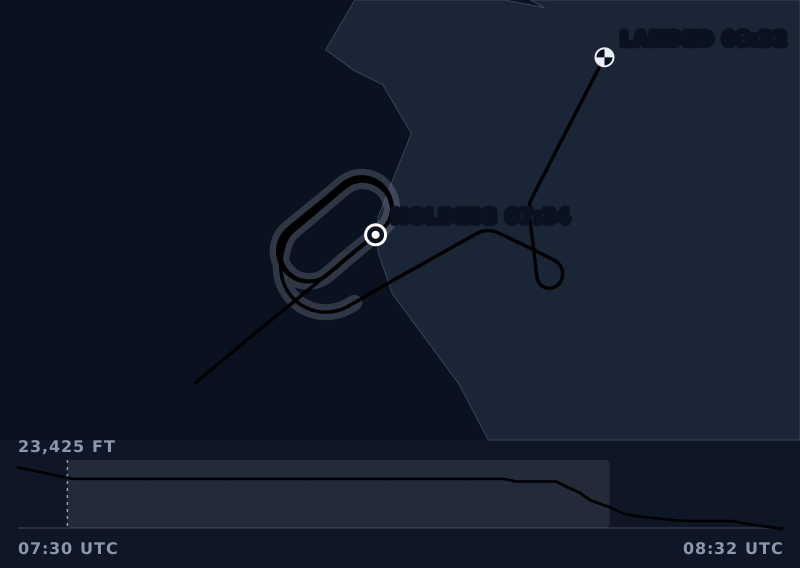
FlyScout's rule checks that a pattern is flown like a hold, not just shaped like one: laps at one height, turned at the steady rate airliners use. It measures how many laps, for how long and at what height, and keeps measuring while the hold goes on, so the finding ends up saying how long it really lasted. What came next is part of the story too: whether the flight landed where it was going or flew somewhere else.
How long can a plane circle?
As long as its fuel allows, with enough left to reach another airport. Every airliner sets off with fuel for the trip, for holding and for flying on to an alternate airport, on top of a final reserve that it must not plan to use. For jets, that reserve is 30 minutes of flying at holding speed, 1,500 ft above the airport.
Controllers give each crew an expected approach time, when it can expect to leave the hold, or tell it that the delay is not yet known. If that time keeps moving later, the crew compares it with the fuel on board. Two calls on the radio say how things stand:
- "Minimum fuel" means the crew is committed to landing at one particular airport and can accept no more delay. It is not an emergency and brings no priority.
- "Mayday fuel" is an emergency. The captain declares it when the fuel expected on landing at the nearest suitable airport would be below the final reserve, and the aircraft gets priority.
A crew watching its fuel diverts long before it would have to use the final reserve.
That is what a long hold sometimes leads to. On the morning in the example above, one flight bound for Carcassonne held for 35 minutes near Toulouse, then flew to Marseille and landed there instead. See why do flights divert.
Holding stacks around London
Londoners know the stacks well, because the same places have heard holding aircraft for decades.
| Airport | Holds | Lowest level |
|---|---|---|
| Heathrow | Four: Bovingdon, Lambourne, Ockham and Biggin, unchanged since the 1960s | 7,000 ft |
| Gatwick | Two: WILLO, above Burgess Hill, and TIMBA, above Heathfield | 7,000 ft |
| Luton | A hold of its own since a recent airspace change; before that it shared two with Stansted |
From the stacks, aircraft do not follow fixed routes to the runway: controllers give each one headings and heights to fly, based on the traffic around it.
London has been cutting holding for years. NATS slows some Heathrow arrivals while they are still far away, now up to 350 NM from London, so that they reach the stack when there is room; it reported that this cut Heathrow's holding by an average of two minutes a flight. It also credits time-based separation of landings, in use since 2015, with saving 1.5 million minutes of airborne holding. It expects UK airspace modernisation to reduce holding further, but says holds will stay essential when demand is high or the weather is poor.
Other planes that circle
Not every circling aircraft is waiting to land:
- A go-around is one loop near the runway after an abandoned landing. See what is a go-around.
- Circuits are repeated approaches to the same runway, usually training. See circuits.
- Military tankers and surveillance aircraft fly long racetracks for hours, far from any airport. See why is a military plane circling.
- Police and air ambulance helicopters circle low over one spot, which a flight tracker shows as small, tight loops.
Questions people ask
Why is my plane circling before landing?
It is most likely in a holding pattern. When more aircraft arrive than the runway can take, air traffic control has some of them fly laps of a published racetrack, each at its own height, until there is room in the landing queue. Busy periods and weather that slows the landing rate are the usual reasons.
How long do planes usually hold?
Usually a few minutes. At Heathrow, about 264 aircraft a day held in 2025, and those that did spent an average of 6.66 minutes in a stack. Holds that short are part of a busy airport's day, which is why FlyScout counts only holds of 30 minutes or more as unusual.
How long can a plane keep circling?
As long as its fuel allows while still reaching an airport with fuel to spare. Every airliner carries fuel for its trip, for holding and for flying to an alternate airport, on top of a final reserve of about 30 minutes that it must not plan to use. If a hold drags on, the crew diverts before it eats into that reserve.
Is holding dangerous?
No. Holds are published, and each aircraft in a stack is kept at its own level, normally 1,000 ft apart, by air traffic control. Stacks have been used around London for decades.
Where are the holding stacks around London?
Heathrow has four, Bovingdon, Lambourne, Ockham and Biggin, whose lowest level is 7,000 ft and whose positions have not changed since the 1960s. Gatwick has two, WILLO above Burgess Hill and TIMBA above Heathfield, and Luton has had a hold of its own since a recent airspace change.
Sources
- NATS: What's the hold up? How holding helps manage aircraft traffic (August 2026)
- Heathrow: Airspace, Noise and ATM Performance, Annual Report 2025
- Heathrow: Arrival flight paths
- Gatwick Airport: Arrivals and holding
- FAA: Aeronautical Information Manual, chapter 5, section 3 (holding)
- SKYbrary: Holding pattern
- ICAO: Doc 8168, Volume II (holding speeds)
- UK CAA: CAP 413, Radiotelephony Manual, edition 24
- UK CAA: CAT.OP.MPA.181, selection of aerodromes and final reserve fuel
- SKYbrary: Minimum fuel
- SKYbrary: Fuel emergencies, guidance for controllers
- NATS: Customer report 2014 (extended arrival management)
- NATS: Responsible business report 2015-16 (cross-border arrival management)
- NATS: Celebrating 10 years of time-based separation (March 2025)