 FLYSCOUT
Why is a plane flying round and round the airport? Circuits explained
A plane that comes down to the runway, climbs away and comes round again, over and over, is flying circuits. With an airliner, it is usually pilots training on a new type, or a flight checking the airport's landing aids. Nothing has gone wrong: the approaches are the point of the flight.
An airliner circling low over an airport, again and again, can look like an aircraft in trouble. It is almost always the opposite: the circling is the whole purpose of the flight. The crew is training, or the aircraft is checking that the airport's landing aids work as they should.
What circuits are
A circuit is a rectangle flown around a runway: take off, turn and fly back alongside it, turn again, line up and land. Light aircraft fly them all day at small airfields. The FAA calls the same rectangle a traffic pattern, with its legs named upwind, crosswind, downwind, base and final.
When an airliner flies circuits it usually does not stop between them. It lands and takes off again without stopping or leaving the runway, a touch-and-go, or comes down to a few feet above the runway and climbs away, a low approach. Then it flies round and does it again.
Why airliners fly circuits
- Pilot training. A pilot moving to a new type of aircraft trains mostly in a simulator, but must also fly take-offs and landings in the real aircraft. Under EASA's guidance, that means at least six landings, or four for pilots with long experience on similar aircraft, including one full-stop landing and one go-around, unless the aircraft's own training data says otherwise. Airlines take an empty aircraft to an airport with room in its schedule and fly circuits there, one trainee after another.
- Checking the landing aids. Instrument landing systems and other navigation aids are checked from the air. The FAA inspects every instrument procedure in the US with its own aircraft; in the UK, the CAA approves a few specialist companies to do it; in Germany, DFS flew night calibration flights at Frankfurt in September 2026 with a King Air 350. These aircraft fly approach after approach along the beams.
- Test flights. A new or repaired aircraft may fly approaches as part of its testing.
- Military training. Air forces fly approach practice at their bases, sometimes with civilian contractors' aircraft.
What circuits look like on a flight tracker
On a map, circuits draw rectangles or long ovals around a runway, laid over each other. The altitude profile looks like teeth: a series of dips down to the runway, each followed by a climb to the same circuit height, a few thousand feet at most.
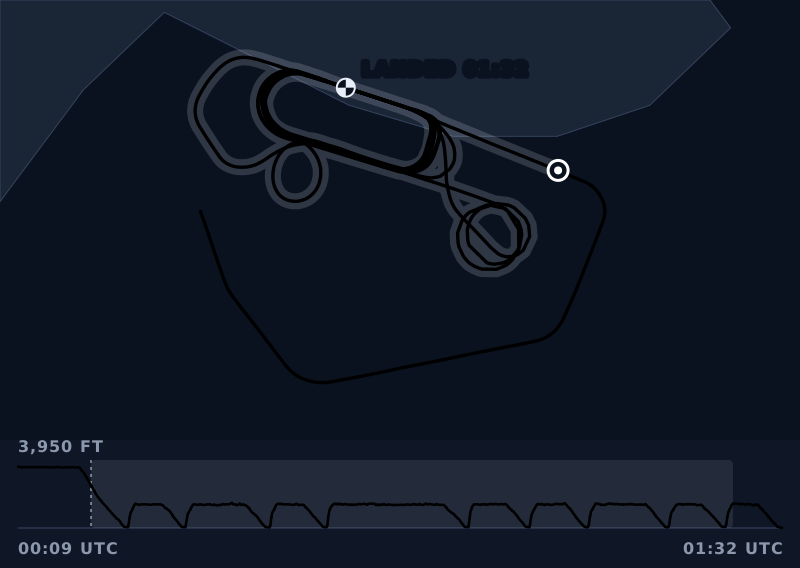
FlyScout counts it as circuits when a jet airliner or freighter comes down towards one airport and climbs away again at least three times without landing. One abandoned approach can happen to anybody, and two happen in bad weather; three in a row are flown on purpose. It measures how many approaches there were, over how long, and how low the lowest one came. On its first full day of watching the world around the clock, from 15 to 16 October 2026, it found 15 of them, at airports from Hannover to Okinawa. Business jets counted then too; since 16 October 2026 they are left out, because some fly circuits for training and contract work almost every day.
In the example above, the 767 flew nine approaches at Hakodate in 70 minutes, most of them six to nine minutes apart. Each one came down to runway level at about 130 knots and climbed away again, and on several of them its transponder reported it on the ground: touch-and-goes.
Where you are likely to see it
Training circuits tend to happen at the same places, because airlines pick airports with long runways and room in the schedule for an aircraft to fly round and round for an hour. Some airports sell it as a service: Glasgow Prestwick, which calls itself one of the UK's most popular training airports, publishes a price per circuit or touch-and-go, from about £32 for the smallest aircraft to about £405 for the largest. Châteauroux, in central France, is another airport known for pilot training.
Flight inspection, on the other hand, can happen at any airport, including the busiest, and often at quiet times of the day or night.
In FlyScout's first full day, besides the 767 at Hakodate, circuits were flown by a German Airways Embraer E190 at Münster, a flight inspection Challenger at Kadena on Okinawa, and Learjets of GFD at Jagel and Hannover. GFD's Learjets fly target-towing and electronic warfare training for Germany's armed forces.
If you live near a training airport, you may see the same aircraft for an hour or two, then nothing for weeks.
Circuits, go-arounds and holds compared
| What you see | What it is | Read more |
|---|---|---|
| One climb away from the runway, then a normal landing | A go-around | What is a go-around |
| Approach after approach to the same runway | Circuits, usually training | This guide |
| Ovals high above, far from the runway, at one height | A hold, waiting to land | Holding patterns |
| Long racetracks for hours, far from any airport | A military tanker or surveillance aircraft | Military planes circling |
Questions people ask
Why is a plane landing and taking off again and again?
It is flying circuits, usually for training. Pilots qualifying on a new aircraft type must fly a number of take-offs and landings in the real aircraft, and an airline brings an empty aircraft to a quiet airport to do it. Flight inspection aircraft also fly repeated approaches to check an airport's landing aids.
What is a touch-and-go?
A landing in which the aircraft touches the runway and takes off again without stopping. Pilots training in circuits often fly several in a row, which on a flight tracker shows as a height that dips to the runway and climbs straight back up.
Is a plane circling the airport in trouble?
Almost never. An aircraft in trouble usually wants to land as soon as it can. One that keeps landing and climbing away, on a calm day, in a neat pattern, is doing it on purpose.
How is this different from a go-around?
A go-around is one landing abandoned, followed by a normal landing. Circuits are approaches flown on purpose, three, five or ten in a row. FlyScout counts three or more approaches without landing at one airport as circuits.
Sources
- FAA: Aeronautical Information Manual, chapter 4, section 3 (traffic patterns)
- SKYbrary: Touch-and-go
- EASA: AMC2 ORA.ATO.125(k), type rating training (ED Decision 2019/005/R)
- FAA: Flight Program Operations
- UK CAA: Approved flight inspection organisations
- DFS: Flight inspection of the instrument landing system at Frankfurt Airport (September 2026)
- Glasgow Prestwick Airport: Training rates (April 2026)
- Glasgow Prestwick Airport: Who we are
- AIN: Châteauroux airport vies for more maintenance business (2015)
- esut.de: Ten more years of target simulation by GFD (December 2025)
- aeroTELEGRAPH: Why Learjets draw strange patterns in the sky (2020)