 FLYSCOUT
Why do flights divert? Diversions explained
A flight diverts when it lands at an airport other than the one it was going to. The usual reasons are weather at the destination, a passenger who needs a doctor, a technical problem, or trouble at the airport itself. Every airliner plans for it before it leaves, with fuel to reach an alternate airport.
When a flight lands somewhere it was not going, the passengers usually find out a few minutes before touchdown. The decision itself is often made much earlier, by a crew weighing the weather, the fuel and the airports within reach. A diversion is one of the ordinary tools of flying, planned for on every flight.
What a diversion is
A diversion is a landing at an airport other than the planned destination, for a reason the crew or the airline could not control, the FAA's definition adds, such as bad weather. If the flight lands back where it started, it is usually called a return, or a turnback; that has its own guide: why did my flight turn back.
A diversion can be decided before take-off, during the flight, or at the very end, after a go-around or a long hold. Most diverted flights land at a nearby airport with a runway long enough for the aircraft, and the airline then decides whether to fly on, send a bus, or find another aircraft.
Why flights divert
- Weather at the destination. Fog, low cloud, snow, thunderstorms or strong crosswinds can bring conditions below what the crew, the aircraft or the airport may land in. The crew may hold for a while, hoping it improves, then divert. Severe weather can send many aircraft to other airports at once.
- A medical emergency. A study of five airlines' records in the New England Journal of Medicine found an in-flight medical emergency on about 1 flight in 604; fainting, breathing problems and nausea were the most common. 7.3% of those flights diverted. Whether to divert is the captain's decision, made mainly on how ill the passenger is and how far it is to the destination, often with advice from doctors on the ground.
- A technical problem. A warning that the aircraft can still fly safely with, but that the crew wants checked on the ground, can mean landing early, often at an airport where the airline has engineers.
- The airport or runway is closed. An accident, a disabled aircraft, a security alert or a runway inspection can close a runway for a while.
- A disruptive passenger. In the UK, the CAA warns that a passenger whose behaviour causes a diversion can be made to pay its full cost, and faces fines and up to two years in prison.
- Fuel. After a long hold or strong headwinds, a crew that would otherwise eat into its final fuel reserve diverts early instead. See holding patterns for the "minimum fuel" and "Mayday fuel" calls.
How every flight plans for it
Diversions are part of the plan before an airliner leaves the gate. Under ICAO's rules, a flight under instrument flight rules must name at least one alternate airport for its destination, and two when the destination's forecast is below the minimum for landing or there is no forecast at all. It may do without one only when good weather is reasonably certain, when the destination has more than one independent runway with an instrument approach, or when the destination is so isolated that there is nowhere else to go; then it carries extra fuel instead.
The fuel on board covers the trip, a hold, the flight to the alternate, and a final reserve on top, 30 minutes for a jet, that the crew must not plan to use.
That is why a diversion is rarely dramatic. When the weather closes in, the crew already knows where it can go, how much fuel that takes, and how long it can wait before it has to leave. Choosing where to go weighs more than distance: the runway, the weather there, the medical and fire services, customs, fuel, the crew's duty hours, and whether the airline can look after its passengers.
What a diversion looks like on a flight tracker
On a map, a diverted flight approaches its destination, often holds or tries to land, then heads off to another airport. The altitude profile tells the story: a descent, a long flat hold or a go-around, a climb back to a few thousand feet, and a second descent somewhere else.
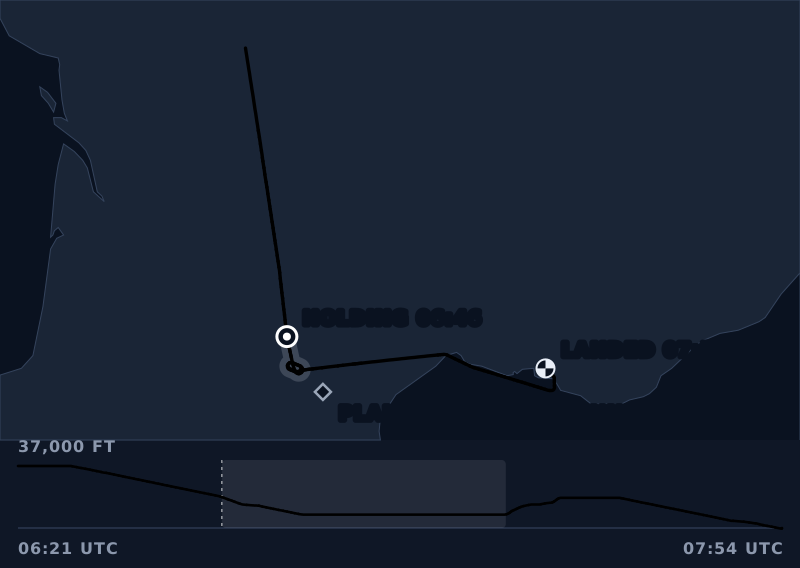
FlyScout judges how each flight it has picked out ends, against the route it was planned to fly. If the aircraft lands somewhere else, the finding says so in a second line, under what happened first: "Diverted to Marseille · planned Carcassonne". If it lands back where it began, it says "Returned". After a go-around, the airport it was trying to land at counts as its plan: a flight that goes around and then lands somewhere else has diverted, whether or not its route is known. It never says why: the track shows where an aircraft went, not the reason, which only the crew and the airline know.
In the example, the 737 held for 35 minutes about 22 NM from Carcassonne, its destination, most of that time at 8,000 ft. Then it climbed away and flew to Marseille. The same morning, two flights bound for Nantes, in western France, held for 28 and 34 minutes before landing there.
What happens to passengers after a diversion
What happens next depends on the reason:
- If the cause clears quickly, such as fog lifting or a passenger handed over to an ambulance, the aircraft may refuel and fly on to its destination.
- If it does not, the airline arranges a bus, a later flight or a hotel. A crew that has reached its legal duty limit may also need to be replaced before the aircraft can go anywhere.
In the UK and the EU, passengers have rights under the air passenger rules, often called UK261 and EU261:
- Care. While you wait, the airline should provide meals and, if needed, a hotel, or pay back reasonable costs. The UK CAA's guidance after the Heathrow closure of March 2025 said airlines should also arrange onward travel.
- Getting you there. If you land at another airport serving the same city or region, the airline must pay for your transfer to the airport you booked. The EU's guidance treats a diversion to an airport that does not serve your destination, Venice to Bologna in its example, as a cancellation, unless the airline takes you on by bus or taxi, when it counts as a delay.
- Compensation. Fixed compensation is due when you arrive three hours or more late, unless the cause counts as extraordinary circumstances, as an airport closure usually does.
Airlines from outside the UK and the EU follow different rules on flights that start elsewhere.
How common diversions are
There is no single public count of diversions worldwide, because each airline and airport keeps its own figures. Only a very small share of flights ever divert to their planned alternate, but across the world's tens of thousands of daily flights, some divert every day, and many at once when fog or storms close a busy airport.
FlyScout notes the ending of every flight it has already picked out for something else, such as a long hold, a go-around or an emergency code. Of the 155 aircraft it saw squawking an emergency code between 18 September and 16 October 2026, at least 12 landed at an airport other than the one they were going to, and 9 more returned to the airport they had left.
Questions people ask
Why would a plane divert to another airport?
Most often because the weather at the destination is below what the crew may land in, because someone on board needs urgent medical care, or because of a technical problem. A closed runway, a disruptive passenger or a long hold that uses up the planned fuel can also send a flight elsewhere.
How do pilots choose where to divert?
Before departure every flight plan names one or more alternate airports, and the aircraft carries fuel to reach them. In the air, the crew and the airline weigh the reason for diverting against the airports in range: runway length, weather, medical or fire services, and whether the airline can look after passengers there.
What happens to passengers after a diversion?
It depends on the reason. If the weather clears or the passenger has been taken to hospital, the aircraft may refuel and continue. Otherwise the airline arranges a bus, another flight or a hotel, and in the UK and EU passengers may have rights to care and compensation, depending on the cause.
Is a diversion the same as an emergency?
No. Many diversions are routine decisions, such as fog at the destination. Some follow an emergency, such as a serious medical case or a technical fault, and the crew may then declare it to air traffic control and set code 7700.
Sources
- FAA: Pilot/Controller Glossary, D (diversion)
- SKYbrary: Alternate aerodrome
- SKYbrary: Fuel, diversion to a weather alternate
- UK CAA: CAT.OP.MPA.181, selection of aerodromes and final reserve fuel
- Peterson et al.: Outcomes of medical emergencies on commercial airline flights, New England Journal of Medicine (2013)
- SKYbrary: Medical emergencies, guidance for flight crew
- UK CAA: Disruptive passengers
- UK CAA: Guidance to consumers affected by the Heathrow Airport incident (March 2025)
- European Union, Your Europe: Air passenger rights, frequently asked questions
- legislation.gov.uk: Regulation (EC) No 261/2004, Article 8