 FLYSCOUT
Why is a military plane circling? Tankers, AWACS and spy planes on station
A military aircraft that flies the same racetrack for hours is on station. Most often it is an air-to-air refuelling tanker waiting for the aircraft it will refuel; otherwise it is a surveillance aircraft, such as an AWACS or a reconnaissance jet, watching an area. Flight trackers show many of them because they broadcast their position like airliners.
You open a flight tracker and see an aircraft drawing the same long oval, over and over, for hours, far from any airport. If it is an airliner, it is waiting to land: see holding patterns. If it is military, it is on station: doing its job in one piece of sky.
Tankers: waiting for the aircraft they refuel
Air-to-air refuelling tankers carry fuel for other aircraft: fighters, transports, surveillance aircraft. They meet them at a published place and height, and fly laps there while the receivers come and go. In the US, the FAA's rules describe a standard refuelling anchor as a left-hand racetrack with legs of at least 50 NM, normally at least 20 NM apart, flown within a block of heights, and allow a tanker to wait in an orbit until its receivers arrive. The UK publishes 14 air-to-air refuelling areas, some always available and others opened by notice, at heights from 2,000 ft up to 29,000 ft.
The tankers you are most likely to see:
| Tanker | Flown by |
|---|---|
| Boeing KC-135 Stratotanker | US Air Force: 414 in service in its 2014 fact sheet, the type having first flown in 1956 |
| Boeing KC-46A Pegasus | US Air Force, from January 2019; up to 179 on order |
| Airbus A330 MRTT | The RAF (Voyager, from Brize Norton), France (Phénix, from Istres), the Multinational MRTT Fleet of six European nations (from Eindhoven and Cologne), Spain (from Torrejón) and Australia (KC-30A, from Amberley) |
| Boeing KC-767A | The Italian Air Force: four aircraft, derived from the 767-200ER |
The A330 MRTT carries up to 111 tonnes of fuel, Airbus says, enough to stay on station far from base for hours.
Surveillance aircraft: watching an area
Early-warning and reconnaissance aircraft also fly long orbits, because their job is to watch one area for as long as possible:
- E-3 Sentry (AWACS), with the large rotating radar dome. NATO owns and flies 14 of its own from Geilenkirchen, in Germany; each operates above 30,000 ft for more than 10 hours, and one can watch more than 312,000 square kilometres.
- E-7 Wedgetail, a Boeing 737 with a radar on its back. Australia flies six; the RAF's first arrived at Lossiemouth in May 2026.
- RC-135 reconnaissance jets of the US Air Force's 55th Wing, which pick up and locate signals. Only two of the RC-135U Combat Sent version exist; the RAF also flies three of the RC-135W Rivet Joint.
- P-8 Poseidon maritime patrol aircraft, built on the Boeing 737, which orbit over the sea. The RAF flies nine from Lossiemouth.
- Global Hawk and its maritime version, the Triton, uncrewed aircraft that fly far above airliners; NATO flies five of its own from Sigonella, in Sicily. See the highest-flying aircraft.
What it looks like on a flight tracker
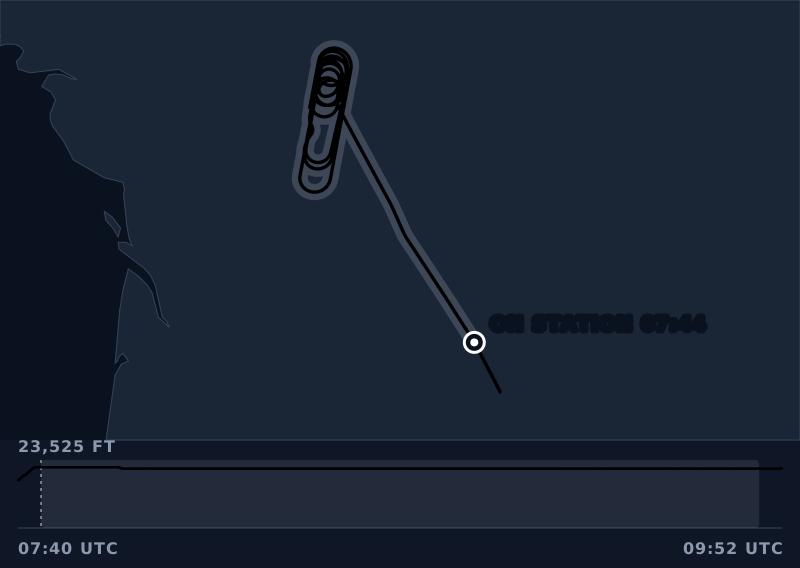
A tanker's station looks like a stretched oval, often tens of miles long, flown at one height. Of the tankers FlyScout has recorded on station, most flew between about 14,000 and 29,000 ft. Surveillance orbits look much the same. Both last far longer than an airliner's hold, and neither is near an airport.
FlyScout's rule looks only at military aircraft of the types built for these jobs, so a trainer's afternoon in the local area is not reported. It counts an aircraft as on station when it has flown at least two and a half laps of one area, above 8,000 ft. It measures the laps, the time, the height and the size of the area, and names the role, tanker or surveillance. It never says whom a tanker was there for, because the track does not show it.
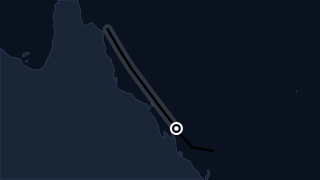
Between 20 September and 16 October 2026, FlyScout recorded 78 military aircraft on station: 67 tankers and 10 surveillance aircraft. The KC-135 was the most common, with 32, ahead of Airbus A330 tankers (19) and Boeing 767 tankers (17). The surveillance aircraft included NATO E-3 Sentries over Spain, a US Air Force RC-135, P-8 Poseidons off Florida, and an E-7 Wedgetail over south-eastern Australia.
Why you can see them at all
Military aircraft fly in the same skies as airliners, and the rules that let controllers see airliners mostly apply to them too:
- In the US, an aircraft with ADS-B must transmit at all times, unless the FAA authorises otherwise for sensitive national defence, security, intelligence or law enforcement missions.
- In Europe, transport-type state aircraft had to carry transponders meeting the full standard, ADS-B included, from December 2020, with exceptions.
- The UK's Ministry of Defence has said its aircraft must use their Mode S transponders when flying alongside civil traffic, and that open-source tracking is a by-product of that. When they are kept apart from civil traffic, they can switch Mode S off.
Tankers and large surveillance aircraft spend much of their time among civil traffic, which is why they appear on trackers far more often than fighters.
What you see is only part of the picture. Aircraft on operations can switch their broadcasts off, and some trackers hide certain military aircraft. Networks that show everything they receive, such as ADSB.lol, show more of them: see how to track military aircraft.
Where tankers and surveillance aircraft are often seen
Between 20 September and 16 October 2026, the most frequent place was the sky near Dubai and Abu Dhabi, with 26 aircraft on station, 23 of them KC-135s, followed by the United States, France and Spain. The tanker in the example took off from Istres, near Marseille, the base of France's A330 tankers, and flew north to its racetrack near Châteauroux. These places change as exercises and operations move; the pattern stays the same.
Questions people ask
Why is a military plane flying in circles?
Most often it is a tanker flying a racetrack while it waits for aircraft to meet it and refuel, or a surveillance aircraft keeping watch over an area. Both stay in one piece of sky for hours, which on a flight tracker looks like an oval drawn over and over.
Why can I see military planes on a flight tracker?
Many military aircraft broadcast their position by ADS-B when they fly in or near civil airspace, as airliners do, which helps air traffic control and other aircraft keep clear of them. Combat aircraft on operations usually do not, so what trackers show is only part of what is flying.
How long do tankers stay on station?
Often one to several hours. The longest FlyScout recorded between 20 September and 16 October 2026, a KC-135 near Mexicali, in Mexico, flew 11 laps over two hours at 22,000 ft.
Is a military plane circling a sign that something is happening?
Not usually. Tankers and surveillance aircraft fly training sorties and routine patrols all the time, often in the same areas week after week. A track shows where an aircraft flew, not why.
Sources
- FAA: Order JO 7610.14A, chapter 5, section 3 (air refuelling anchors)
- FAA: Order JO 7610.14A, chapter 5, section 1 (air refuelling)
- NATS: UK AIP ENR 5.2, military exercise and training areas (October 2026)
- US Air Force: KC-135 Stratotanker fact sheet
- US Air Force: KC-46A Pegasus fact sheet
- Airbus: A330 MRTT
- Royal Air Force: Voyager
- French Air and Space Force: A330 Phénix fact sheet
- OCCAR: Multinational MRTT Fleet declared initial operating capability (March 2023)
- Royal Australian Air Force: KC-30A MRTT
- Italian Ministry of Defence: KC-767A contract document (October 2025)
- Air Combat Command: RC-135V/W Rivet Joint fact sheet
- Air Combat Command: RC-135U Combat Sent fact sheet
- NATO: AWACS, NATO's eyes in the sky
- Royal Australian Air Force: E-7A Wedgetail
- Royal Air Force: First Wedgetail aircraft arrives at RAF Lossiemouth (May 2026)
- Royal Air Force: Poseidon MRA1
- NATO: Intelligence, surveillance and reconnaissance force (RQ-4D Phoenix)
- eCFR: 14 CFR 91.225, ADS-B Out equipment and use
- legislation.gov.uk: Regulation (EU) No 1207/2011, Article 8
- UK Defence Journal: Ministry of Defence allays concerns over open-source tracking of military aircraft (May 2018)