 FLYSCOUT
What is a go-around? Why your plane aborted its landing
A go-around is a landing that the pilots or air traffic control call off on purpose. The engines go to take-off power, the aircraft climbs away from the runway, and controllers bring it back round to land, typically a quarter of an hour later. It is a routine safety manoeuvre, not a near miss.
A go-around is the moment on approach when, instead of landing, the engines roar back up and the aircraft climbs away from the runway. For passengers it can be a surprise. For the crew it is an ordinary decision with a procedure set out in advance: climb, tidy up the aircraft, and come back round.
What a go-around is
An aircraft on its final approach abandons the landing: the crew sets take-off thrust, the aircraft climbs away, and the flaps and landing gear are raised as it goes. The route it then flies is published for every runway, so the pilots and the controllers both know where it is going. At Gatwick, for example, it climbs ahead, turns south and levels off at 3,000 ft, and controllers then bring it round for another approach.
You will hear several names for much the same thing:
- Go-around: what pilots and controllers call abandoning an approach, and the instruction a controller gives.
- Missed approach: the procedure flown when an instrument approach cannot be completed to a landing.
- Aborted landing: the passengers' word for it.
Why planes go around
The decision can come from the cockpit or from air traffic control. The common reasons:
- The runway is not clear. The aircraft ahead has not turned off yet, a departing aircraft is slow to start its take-off roll, or the runway is being inspected after debris or a bird strike.
- The approach is not stable. The Flight Safety Foundation's widely used criteria say an approach must be stable by 1,000 ft above the airport in cloud, or 500 ft in clear weather: in the landing configuration, within 20 knots of its target speed, descending no faster than 1,000 ft a minute, and on the glide path. If it is not, or stops being stable lower down, the crew goes around.
- Wind and weather. Gusts, wind shear, a strong crosswind, or low cloud and fog: if the crew cannot see the runway by the minimum height for the approach, they must go around.
- Spacing and clearance. The controller sends an aircraft around if it has caught up too closely with the one ahead, or if it has no clearance to land.
- Something not ready. A technical problem the crew wants to check, or, as Gatwick lists, passengers not yet in their seats.
Gatwick publishes the causes its controllers record. In 2021 they were:
| Cause recorded at Gatwick, 2021 | Share of go-arounds |
|---|---|
| Runway occupied | 27% |
| Weather, such as wind shear | 23% |
| Unstable approach | 22% |
| Airline operational reasons | 12% |
| Airport operational reasons | 10% |
| Other operational reasons | 4% |
| Air traffic control reasons | 3% |
What it feels like on board
The first sign is the sound: the engines go from almost idle to take-off thrust in a few seconds. The nose rises and the aircraft climbs. You may hear the landing gear come up and the flaps move. When the workload eases, the crew usually explains what happened.
The aircraft then flies a circuit or is turned by controllers to line up again. A study of go-arounds at 20 European airports found that the median time from going around to landing was between 11.5 and 16.5 minutes, depending on the airport, and that the aircraft flew a further 36 to 58 NM. The A330 in the example below landed 17 minutes after it went around.
How common go-arounds are
About 3 landings in 1,000 end in a go-around. The European study, which used ADS-B data like FlyScout's, counted 20,196 go-arounds in 6.7 million landings between 2019 and 2023: 3.1 per 1,000 on average, from about 1.5 at Rome Fiumicino to about 6 at Istanbul Sabiha Gökçen. Heathrow had 2,326 in 612,412 landings, about 3.8 per 1,000. The Flight Safety Foundation's study of about 500,000 flights found a similar rate: 1 approach in 340.
Across the world they add up. In its first full day of watching the world's flights around the clock, from 15 to 16 October 2026, FlyScout found 171 airliners, freighters and business jets that went around, nine of them twice, at airports from Los Angeles to Narita. That is a count of what its rule caught, not of every go-around flown: an airport out of reach of the receiver networks, or a go-around too quick to show between two of FlyScout's looks at the world, can be missed.
What a go-around looks like on a flight tracker
On a map, a go-around is a track that comes down towards the runway, then climbs and swings round in a wide loop before lining up again. The altitude profile shows it best: a steady descent, a dip, and a sharp climb of a few thousand feet before the second descent to land.
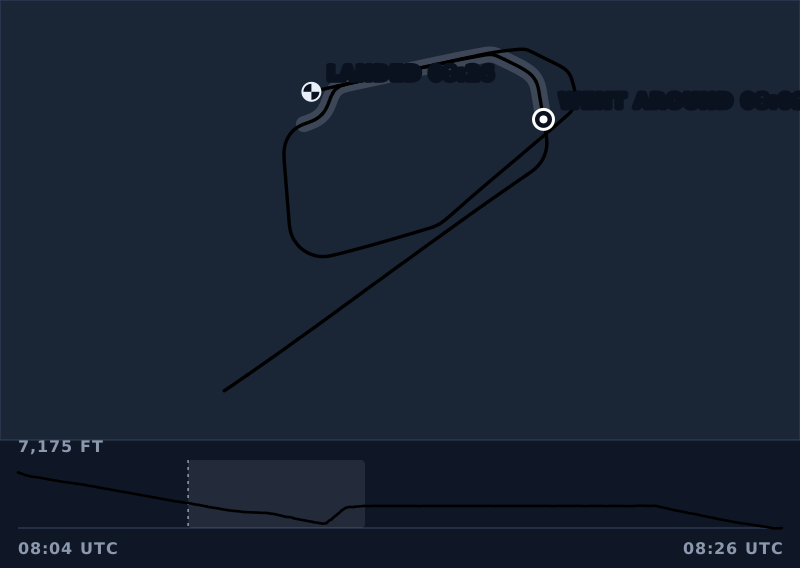
FlyScout's rule looks for exactly that shape near an airport: an aircraft that came down to within 2,000 ft of the airport's height, within 10 NM of it, then climbed at least 700 ft away again. It measures the lowest point, how far out it was, and how much and how fast it climbed. If the aircraft goes around a second time, the same finding says so: "Two go-arounds".
Since 16 October 2026, FlyScout's feed and alerts show the go-arounds that stand out: a flight that went around twice, landed somewhere else afterwards, or was one of several at the same airport within the hour. The others are real but ordinary, well over a hundred a day around the world.
Two things to keep in mind when you read the numbers:
- Heights come from the transponder. Trackers show the pressure altitude an aircraft reports, measured against a standard air pressure. Near the ground, on a day of high or low pressure, it can be a few hundred feet away from the true height above the runway.
- Three or more approaches in a row are something else. An aircraft that comes down to the runway and climbs away again and again is flying circuits, usually for training. See circuits.
Is a go-around dangerous?
No. NATS calls a go-around the safest course of action at that moment, and Gatwick describes it as perfectly safe. The Flight Safety Foundation calls it a normal flight manoeuvre, one that crews train for and fly without hesitation.
What safety experts worry about is the opposite: crews pressing on with a landing that should have been abandoned. The Foundation found that unstable approaches happen on 3.5 to 4% of approaches, yet only about 3% of them end in a go-around; the rest continue to land. Unstable approaches were a factor in two thirds of the approach and landing accidents and serious incidents it studied in the 1980s and 1990s. That is why the Foundation's criteria call for an immediate go-around whenever an approach falls outside the limits.
When a go-around is followed by a diversion
Most aircraft land at the next attempt. If the reason for the go-around does not go away, such as fog, a strong crosswind or a blocked runway, the crew may hold for a while or fly to another airport. In FlyScout's first full day, one airliner went around twice at Ontario, California, then landed at Los Angeles instead. Why flights land somewhere else is covered in why do flights divert.
Questions people ask
Is a go-around an emergency?
No. It is a normal manoeuvre that crews train for and fly whenever a landing does not look right. NATS, which runs air traffic control in the UK, calls it the safest course of action at that moment, and Gatwick Airport describes it as perfectly safe. The aircraft climbs away on a published route, rejoins the arrival queue and lands.
How common are go-arounds?
About 3 in every 1,000 landings. A study of 6.7 million landings at 20 European airports from 2019 to 2023 found an average of 3.1 per 1,000, from about 1.5 at Rome Fiumicino to about 6 at Istanbul Sabiha Gökçen. On 15 to 16 October 2026, FlyScout found 171 flights going around worldwide in a single day.
Why did my plane suddenly climb just before landing?
The crew or air traffic control decided not to land on that attempt. The usual reasons are a runway that is not clear, an approach that is too high, too fast or not lined up, gusty wind or wind shear, or the runway not being in sight at the minimum height. The crew then follows a published procedure and comes round again.
How long does a go-around add to a flight?
Usually around a quarter of an hour. In the European study, the median time from going around to landing was between 11.5 and 16.5 minutes, depending on the airport, and the aircraft flew a further 36 to 58 NM. If the cause does not go away, the crew may hold or divert instead.
Can a plane go around just above the runway?
Yes. In flight data from about 500,000 flights studied by the Flight Safety Foundation, 15% of go-arounds began below 200 ft and 7% below 50 ft, just above the runway.
Sources
- Flight Safety Foundation: Go-Around Decision-Making and Execution Project, final report (March 2017)
- Flight Safety Foundation: ALAR Briefing Note 7.1, Stabilized approach
- Flight Safety Foundation: ALAR Briefing Note 6.1, Being prepared to go around
- Figuet et al.: Go-arounds at 20 European airports, Journal of Open Aviation Science
- NATS: Why a go-around is nothing to fear (August 2022)
- Gatwick Airport: Go-arounds information pack (2025)
- Gatwick Airport: Airspace Office Annual Report 2021
- SKYbrary: Missed approach
- SKYbrary: Executing a soft go-around, guidance for flight crews
- FAA: Pilot/Controller Glossary, M (missed approach)
- eCFR: 14 CFR 91.227, ADS-B Out equipment performance requirements