 FLYSCOUT
Rare military aircraft you can see on flight trackers
Most military aircraft on a flight tracker are tankers and transports that fly every day. Now and then something rarer appears: a U-2 spy plane, a Russian Antonov An-124, a Chinese Y-20 or a vintage Hawker Hunter. FlyScout tells them apart by counting how often each type is seen in the air, not by keeping a list.
Most military aircraft on public flight trackers are ones that fly every day: tankers, transports, trainers. The rare ones stand out precisely because they turn up once in a few weeks, and enthusiasts watch for them.
How FlyScout decides what is rare
There is no list of rare aircraft in FlyScout. Every few minutes, its military scan looks at the military aircraft in the air around the world and notes which types it saw that day. Over the last 30 days, that becomes a census: a KC-135 tanker is up every day, a U-2 on two or three days a month.
A type counts as rare when it has been seen in the air on no more than one day in ten of the days FlyScout watched, and only after at least a week of watching, so that both weekdays and a weekend are counted. When a fleet is retired or a new type starts flying, the census notices by itself. The finding says how rare: "seen on 3 of the last 21 days".
What FlyScout has seen
Between 26 September and 15 October 2026, FlyScout recorded 27 rare sightings. The types seen more than once:
| Type | What it is | Where FlyScout saw it |
|---|---|---|
| Xi'an Y-20 Kunpeng | Chinese military transport | Near Nanjing, Pingliang and Mianyang, China |
| Sikorsky CH-53 | Heavy-lift helicopter | Near San Diego and Tijuana |
| Antonov An-124 Ruslan | Russian heavy transport | Near Larnaca, Cyprus |
| Lockheed U-2S | High-altitude reconnaissance | Near Sacramento, California |
| Antonov An-30 | Aerial survey aircraft | Near Bucharest, Romania |
| Dassault Mirage 2000 | French fighter | Southern France |
| Ilyushin Il-62 | Russian four-engined jet | Near Moscow |
| Lockheed Martin F-35 | Fighter | Near Peterborough, England, and Phoenix, Arizona |
| Aermacchi M-346 | Advanced jet trainer | Near Bologna and Cagliari, Italy |
Single sightings included a Hawker Hunter near Leeds, a Belgian Air Force F-16 over south Wales, an F-15 near Norwich, a Czech Air Force L-159 near Brno, a UH-1Y helicopter near Olomouc and a Sikorsky S-92 near Montréal.
What some of them are:
- Lockheed U-2S. A high-altitude reconnaissance aircraft of the US Air Force, routinely flown above 70,000 ft by the 9th Reconnaissance Wing from Beale Air Force Base in California.
- Antonov An-124 Ruslan. One of the largest transport aircraft ever built. The US Treasury, sanctioning several in 2024, linked them to Russia's military transport aviation command.
- Xi'an Y-20 Kunpeng. China's large military transport, in service since July 2016; a tanker version, the YY-20A, also exists.
- Antonov An-30. A photo-mapping and reconnaissance aircraft. Romania flies two, and has used them for observation flights under the Open Skies Treaty.
- Hawker Hunter. A 1950s jet fighter design, still flown in the UK by Hawker Hunter Aviation from RAF Leeming, under contract to the RAF and other NATO forces for threat simulation and trials.
Why rare aircraft appear at all
Military aircraft that share airspace with civil traffic generally keep their transponders on, so that air traffic control and other aircraft can see them; the UK's Ministry of Defence calls open-source tracking a by-product of that. A rare type often appears on a transit flight between bases, during an exercise, or on a training flight near home.
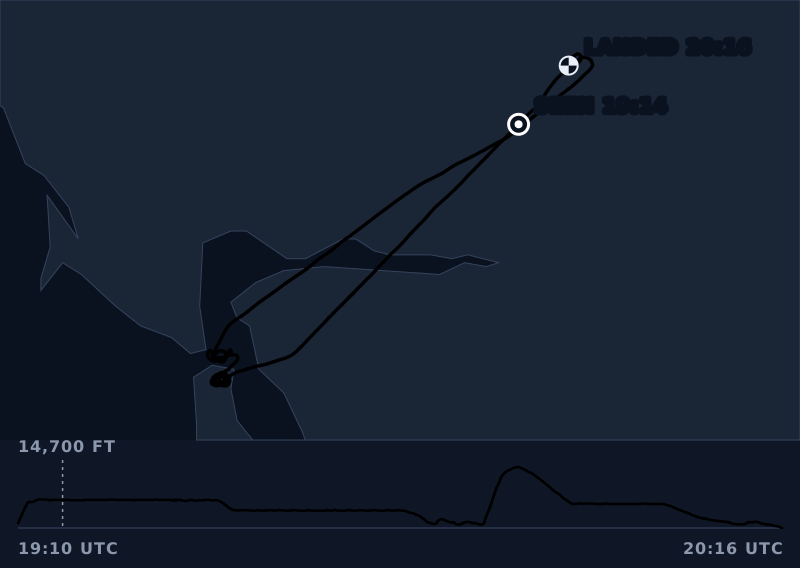
Some never broadcast a position at all. The receiver networks can still place an aircraft that sends other transponder messages, by timing its signals at several receivers: multilateration, or MLAT. The U-2 in the example was placed that way, so its line is a calculated estimate. See MLAT explained.
Rarities people search for
Some of the most searched-for military aircraft rarely appear at all:
- E-4B Nightwatch, often called the "doomsday plane": four Boeing 747-based airborne command posts of the US Air Force, at Offutt Air Force Base in Nebraska, with at least one on alert around the clock.
- E-6B Mercury, the US Navy's airborne command post and communications relay, flown from Tinker Air Force Base in Oklahoma.
- Air Force One. That is the callsign of any Air Force aircraft carrying the US president, usually one of two VC-25A, Boeing 747s. Flightradar24 says it does not display Air Force One.
Where to look
Rare military aircraft tend to turn up near the bases they fly from, along transit routes between continents, and around exercises, wherever volunteer receivers are close enough to hear them.
If you want to follow them as a hobby, see how to track military aircraft, which compares the trackers that show military aircraft and those that hide them.
What FlyScout does not say
FlyScout reports a rare type in the air, where, and how rare: it never guesses at the mission. A U-2 near Sacramento, or an An-124 over Cyprus, is a fact on a track; what it is doing there is not in the data.
Questions people ask
Can you see spy planes on a flight tracker?
Sometimes. Some reconnaissance aircraft, such as the RC-135 and the U-2, appear on public trackers when their transponders are on, either broadcasting their own position or placed by the receiver network from their signals. What is shown is only a part of what flies, and only when the crew lets itself be seen.
What is the rarest aircraft on Flightradar24?
There is no fixed answer, because rarity changes with what air forces fly that week. FlyScout measures it instead: a type counts as rare when it has been seen in the air on no more than one day in ten over the last month.
Why do military aircraft show up on flight trackers at all?
Many broadcast their position when flying in or near civil airspace, as airliners do, so that air traffic control and other aircraft can see them. Aircraft on operations can switch this off, and some trackers hide certain military aircraft.
How does FlyScout decide what is rare?
Its military scan looks at the world's military aircraft every few minutes and keeps a census of the days on which each type was in the air. A type seen on no more than a tenth of the days watched, over up to 30 days, is rare, and FlyScout says how many days it was seen.
Sources
- Air Combat Command: U-2S/TU-2S fact sheet
- US Treasury, OFAC: Recent actions (January 2024)
- Henan provincial government (China Daily): Y-20 Kunpeng (August 2026)
- Royal International Air Tattoo: Antonov An-30, Romania (2022)
- Forces News: Antonov 30, a Soviet plane still proving its worth (July 2022)
- Royal International Air Tattoo: Hawker Hunter Mk58, Hawker Hunter Aviation (2023)
- US Air Force: E-4B fact sheet
- US Navy: E-6B Mercury fact file
- Air Mobility Command: VC-25A fact sheet
- Flightradar24 Support: Why does it say that a flight is blocked?
- UK Defence Journal: Ministry of Defence allays concerns over open-source tracking of military aircraft (May 2018)