 FLYSCOUT
The highest-flying aircraft you can see on a flight tracker
Airliners cruise below about 43,000 ft, and the highest business jets are certified to 51,000 ft. Above that, a flight tracker shows only a handful of aircraft, nearly all military: the U-2 spy plane, the uncrewed Global Hawk and Triton, NASA's WB-57 and ER-2. FlyScout picks out anything flying for a sustained stretch above 52,000 ft.
Look at the altitudes on a flight tracker and almost every aircraft is somewhere between 30,000 and 43,000 ft at cruise. That band is crowded for a reason: airlines ask for the most fuel-efficient level they can get, and EUROCONTROL reports that the share of flights in Europe asking for more than 35,000 ft rose from 6% in 1995 to 40% in 2021. Far above it, in air too thin for airliners, a few aircraft are built to work.
How high airliners and business jets fly
Airliners are certified to fly up to about 41,000 to 43,000 ft, depending on the type: EASA's type certificate gives the Boeing 787-8 and 787-9 a maximum operating altitude of 43,100 ft, and the 787-10 41,100 ft. The height of 41,000 ft has long been a line in the rules: when the FAA certified the Cessna Citation X to fly above it in 1994, it treated that as novel and wrote special conditions, and under US airline rules, above 41,000 ft one of the two pilots must wear an oxygen mask whenever the other leaves the controls.
Business jets climb higher: the Gulfstream G700 and G800 and the Cessna Citation X+ can fly at up to 51,000 ft.
What flies above 52,000 ft
| Aircraft | Who flies it | How high |
|---|---|---|
| Lockheed U-2S | US Air Force, reconnaissance, from Beale in California | Routinely above 70,000 ft |
| ER-2 | NASA, research: two aircraft, endurance 8 hours | Up to 70,000 ft |
| WB-57 | NASA, research: three aircraft, from Ellington Field in Texas | Above 63,000 ft |
| RQ-4 Global Hawk | US Air Force (nine), NATO (five, from Sigonella) | Up to 60,000 ft |
| MQ-4C Triton | US Navy, Royal Australian Air Force | 52,000 ft in FlyScout's records |
| Concorde (retired 2003) | British Airways, Air France | Cruised at 60,000 ft |
These are the aircraft built to stay up there for hours. In 2024, a Global Hawk set the US Air Force's record for the longest flight without refuelling, at 34.8 hours.
What FlyScout looks for
FlyScout's military scan picks out any military jet flying above 52,000 ft for at least ten minutes: higher than any airliner or business jet is certified to go. It only believes types it knows to be jets, because a turboprop or piston aircraft reporting 60,000 ft has a faulty altimeter, not a record. It measures how long the aircraft stays up there and how high it goes, and keeps measuring while the flight goes on.
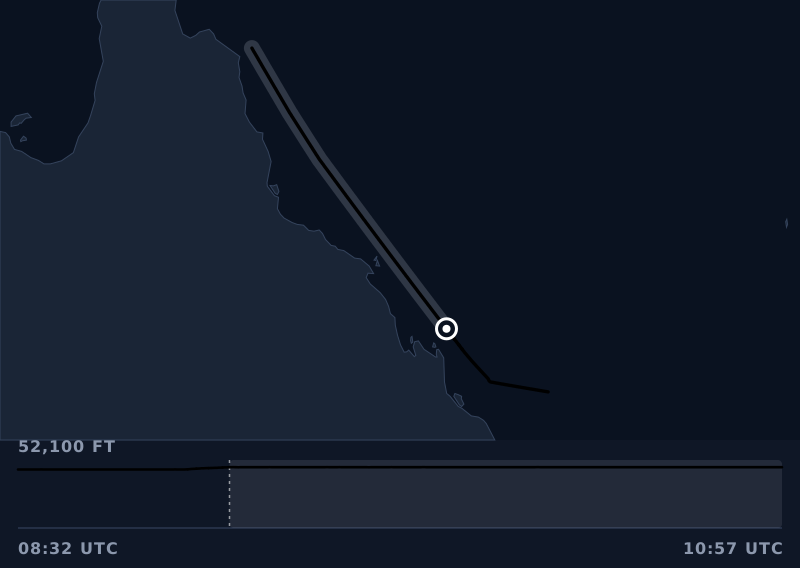
Between 24 September and 16 October 2026, FlyScout recorded three such flights, all by uncrewed aircraft of the Global Hawk family: the Australian Triton above, twice, at 52,000 ft, and another at 59,000 ft over the Ionian Sea, whose position was calculated by the receiver network rather than broadcast. The U-2 has appeared in FlyScout's records too, but lower down, near its base, with its positions calculated by the network: see rare military aircraft.
Why they fly so high
- Surveillance. From 60,000 ft, the horizon is hundreds of miles away, so a sensor sees a vast area, and the aircraft is above the weather and other traffic.
- Science. Research aircraft carry instruments into the upper atmosphere, above most of the weather.
- Endurance. The uncrewed Global Hawk can stay up for well over a day: 34.8 hours on its record flight.
Seeing them on a flight tracker
High flyers are military or government aircraft, so the same limits apply as for other military aircraft: many are not shown at all, and those that are may be hidden by some trackers. See how to track military aircraft.
When one appears, the altitude is the giveaway. A line that sits at 52,000 or 60,000 ft for an hour or more, when everything else around it is at 35,000, is not an airliner.
Questions people ask
What is the highest-flying aircraft?
Among aircraft flying today, the U-2 reconnaissance jet, routinely flown above 70,000 ft, and NASA's ER-2 research aircraft, with a maximum of 70,000 ft, fly highest. NASA's WB-57 flies above 63,000 ft and the uncrewed Global Hawk up to 60,000 ft. Concorde cruised at 60,000 ft until it was retired in 2003.
How high do airliners fly?
Most cruise somewhere between about 30,000 and 41,000 ft. Their maximum operating altitudes are a little higher: EASA certifies the Boeing 787-8 and 787-9 to 43,100 ft, for example, and the 787-10 to 41,100 ft. Above 41,000 ft, extra rules on pressurisation and oxygen apply.
Why do some aircraft fly so high?
Height gives a surveillance aircraft a long view and keeps it clear of weather and other traffic, and it lets research aircraft sample the upper atmosphere. NATO says its Global Hawks fly well above civilian air traffic, at more than 50,000 ft.
Can you see a U-2 on a flight tracker?
Sometimes. U-2s have appeared on public trackers near their home base in California, usually placed by the receiver network from their signals rather than by a position they broadcast, and often at much lower heights on the way in or out.
Sources
- ADF-Serials: RAAF A57 Northrop Grumman MQ-4C Triton
- EASA: Type certificate data sheet IM.A.115, Boeing 787 (December 2025)
- Gulfstream: G700
- Gulfstream: G800
- Textron Aviation: Cessna Citation X makes first transatlantic trip (2014)
- Federal Register: Special conditions, Cessna Model 750, operation above 41,000 ft (1994)
- eCFR: 14 CFR 121.333, Supplemental oxygen
- Air Combat Command: U-2S/TU-2S fact sheet
- NASA Airborne Science: ER-2
- NASA ESPO: WB-57
- Air Combat Command: RQ-4 Global Hawk fact sheet
- US Air Force: RQ-4 Global Hawk fact sheet (2014)
- NATO: Intelligence, surveillance and reconnaissance force (RQ-4D Phoenix)
- NATO Allied Air Command: NATO Alliance Ground Surveillance Force update (September 2023)
- PBS NOVA: Flying Concorde
- EUROCONTROL: Data snapshot 21, aircraft flying higher, more efficiently and sustainably (November 2021)