 FLYSCOUT
What an emergency descent looks like on a flight tracker
An emergency descent is a fast, deliberate dive from cruise height to about 10,000 ft, where people can breathe without oxygen masks, or to the lowest safe height where the ground is higher. Crews fly one after a sudden loss of cabin pressure or a fire. On a flight tracker it shows as a drop of 20,000 ft or so in a few minutes, then level flight lower down. Most fast descents on a tracker are not emergencies, though.
A track that drops from 35,000 ft to 10,000 ft in a few minutes looks alarming, and sometimes it is: it is what an airliner does when it loses cabin pressure. But fast descents happen for ordinary reasons too, and the shape of the track usually tells you which.
Why crews make emergency descents
Airliners cruise where the air is far too thin to breathe for long. The cabin is pressurised to keep it breathable; if that pressure is lost suddenly, or if there is a fire and the crew needs to land quickly, the crew dives for thicker air.
How little time there is shows in the FAA's table of time of useful consciousness, how long a person can act sensibly without extra oxygen:
| Altitude | Time of useful consciousness | After a rapid decompression |
|---|---|---|
| 25,000 ft | 3 to 5 minutes | 1.5 to 2.5 minutes |
| 30,000 ft | 1 to 2 minutes | 30 seconds to 1 minute |
| 35,000 ft | 30 seconds to 1 minute | 15 to 30 seconds |
| 40,000 ft | 15 to 20 seconds |
That is why the crew's first action is to put on their own oxygen masks, before anything else.
How an emergency descent is flown
SKYbrary, the safety library backed by EUROCONTROL, describes the procedure: the crew descends at or near the aircraft's maximum speed, with the engines at idle and the speed brakes out, unless they suspect structural damage. The target is about 10,000 ft, where people can breathe without masks, or the lowest safe altitude for the area if the ground is higher than that.
Passengers breathe from masks that drop automatically if the cabin altitude goes above about 14,000 ft. The oxygen is made by chemical generators that cannot be switched off once started, and Airbus notes that the burning smell they give off is normal. Regulations require at least 10 minutes of passenger oxygen, and most generators last 12 to 20 minutes, enough to reach breathable air. US rules size the crew's oxygen for a descent from the aircraft's maximum altitude to 10,000 ft in 10 minutes. Over high mountains, airlines plan escape routes so that an aircraft can get down safely before the passengers' oxygen runs out.
The crew also sets the transponder to 7700, which alerts controllers below as well. SKYbrary notes that this can come late, because it is often the last item of the drill.
What it looks like on a flight tracker
An emergency descent has a distinctive shape: a steady cruise, then a steep drop of 15,000 to 25,000 ft in a few minutes, then level flight at around 10,000 ft, often followed by a diversion to the nearest suitable airport. An accident report by Japan's transport safety board gives one real example: an Airbus A300 descending from 33,000 ft at about 5,000 ft a minute.
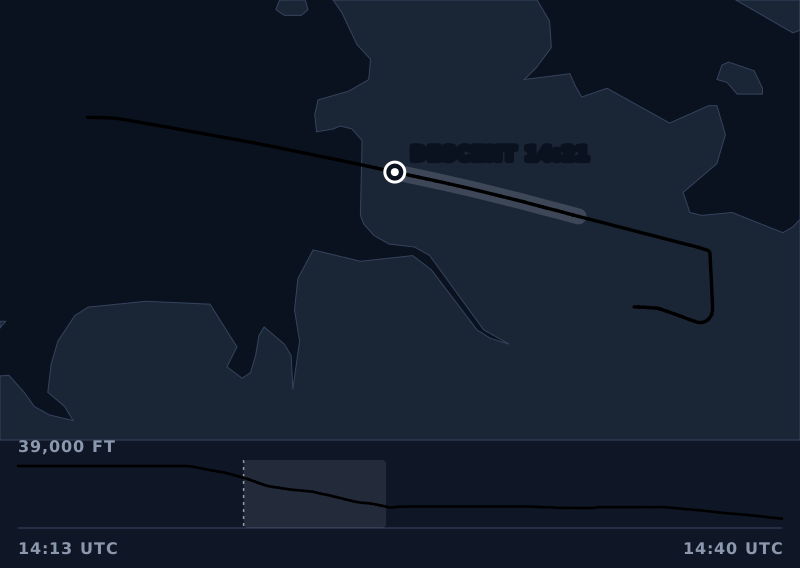
FlyScout's rule calls it a rapid descent when an airliner, freighter or business jet comes down from above 20,000 ft at 4,500 ft a minute or more, far faster than a normal descent, and then levels off between 8,000 and 13,500 ft, the band where an emergency descent ends, flying on rather than into a hold; or when it squawks 7700 on the way down. It measures where the descent began and ended and the fastest rate. The finding says what the track shows and nothing more: how fast it came down says nothing of why.
The example is a case in point. The A321neo above, flown by Airbus itself, dropped 18,400 ft in five minutes and levelled off at 13,200 ft, exactly the profile of an emergency descent, and then flew on and landed normally where it had started.
Most fast descents are not emergencies
In its first full day of watching the world around the clock, from 15 to 16 October 2026, FlyScout found 20 rapid descents. Only one levelled off near 10,000 ft: the Airbus above. None of the other 19 did, and most carried straight on down to land, which is what a steep but normal arrival looks like. Since 16 October 2026, FlyScout publishes a fast descent only when it levels off like that, or comes with an emergency code.
Airliners descend fast for ordinary reasons:
- Air traffic control asks. Controllers may ask a crew to expedite a descent, to clear the level for another aircraft. Crews then descend at the best rate they can, slowing only for the last 1,000 ft before the new level.
- A late or steep descent to an airport. A crew kept high by controllers, or short-cut onto the approach, has to lose height quickly. Some airports have steep approaches built in: London City's glide path is 5.5 degrees, against the usual 3.
- Business jets. Five of the 20 FlyScout found were business jets rather than airliners.
For comparison, on the final approach an airliner comes down at no more than about 1,000 ft a minute. The difference between a fast normal descent and an emergency descent is in the shape. A normal descent, however steep, carries on down to land. An emergency descent stops at about 10,000 ft and stays there.
Seeing one live
If you see an aircraft drop fast from cruise on a tracker, look for three things: whether it levels off around 10,000 ft, whether it squawks 7700, and whether it turns towards an airport that was not its destination. All three together point strongly to an emergency; any one alone may not. See what does squawk 7700 mean and why do flights divert.
Questions people ask
Why do planes make emergency descents?
Mostly because the cabin has lost pressure, or because of a fire on board. At cruise height the air is too thin to breathe, so the crew puts on oxygen masks and descends as fast as the aircraft safely can to about 10,000 ft, or to the lowest safe height above high ground.
How fast is an emergency descent?
Several thousand feet a minute. Crews fly near the aircraft's maximum speed with the engines at idle and the speed brakes out, unless they suspect structural damage. One accident report describes an Airbus A300 descending from 33,000 ft at about 5,000 ft a minute.
How long does passenger oxygen last?
Long enough to reach breathable air. Regulations require at least 10 minutes of oxygen for passengers, and most chemical oxygen generators last 12 to 20 minutes. The masks drop automatically if the cabin altitude climbs above about 14,000 ft.
Does a fast descent on Flightradar24 mean an emergency?
Usually not. Airliners often descend fast when controllers ask them to, or to make a steep approach. What marks an emergency descent is a dive from cruise that stops at around 10,000 ft and stays level there, often with code 7700 set, rather than continuing straight on to land.
Sources
- SKYbrary: Emergency descent, guidance for flight crews
- SKYbrary: Emergency descent, guidance for controllers
- SKYbrary: Mountainous terrain escape routes
- eCFR: 14 CFR 121.333, Supplemental oxygen for emergency descent and for first aid
- Airbus: Flight operations briefing note, cabin decompression (2007)
- FAA: Advisory Circular 61-107B, Aircraft operations at altitudes above 25,000 feet
- Japan Transport Safety Board: Aircraft accident report AI2011-1
- FAA: Aeronautical Information Manual, chapter 4, section 4 (ATC clearances and aircraft separation)
- EUROCONTROL: HindSight 16 (winter 2012)
- UK AAIB: Bulletin 11/2006, Avro 146-RJ100 G-CFAH (London City approach)
- Flight Safety Foundation: ALAR Briefing Note 7.1, Stabilized approach